
Why Modrić, Kroos and Casemiro Were Football’s Perfect Midfield Trio.

Abdullah Al Masum
Thu, Oct 29, 2026
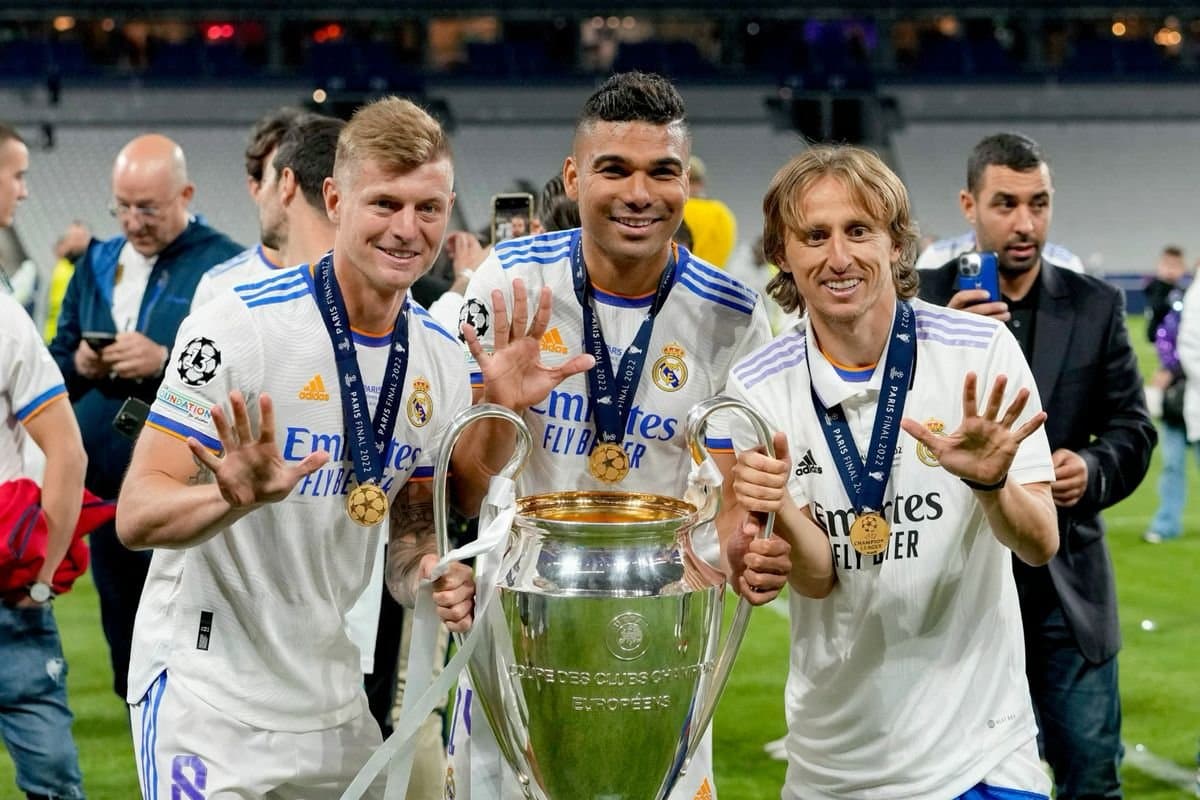
When we think of Real Madrid’s dominance over the last decade, the first names that often come to mind are the legendary BBC frontline of Cristiano…
When we think of Real Madrid’s dominance over the last decade, the first names that often come to mind are the legendary BBC frontline of Cristiano Ronaldo, Karim Benzema and Gareth Bale, or the devastating partnership between Vinícius Júnior and Benzema. Their goals, pace and individual brilliance produced some unforgettable moments. Yet behind much of that attacking firepower stood three midfielders whose influence deserves equal recognition: Luka Modrić, Toni Kroos and Casemiro.
Together, they formed a midfield built on balance, intelligence and control. Modrić could glide past opponents as if threading a needle through a crowded defence, reading the game with remarkable calm and finding passes that others could barely see. Kroos brought precision and composure, dictating the tempo with his exceptional passing range and ability to move the ball exactly where Madrid needed it. Casemiro provided the muscle and defensive aggression, breaking up attacks, winning duels, and protecting the back line so that his partners could focus on creating chances.
Their influence went far beyond keeping possession. They helped Madrid build attacks, break through pressing lines, recover the ball and prevent opponents from taking control. They were not simply three outstanding players sharing a pitch; they were three complementary forces that made one another better.
To understand Madrid’s European dominance, we must look beyond the goals and examine the midfield that helped make them possible.
Three Players, Three Different Jobs
The trio’s story properly took shape in the 2015–16 season. Modrić had joined Madrid in 2012, Kroos arrived in 2014, and Casemiro returned from his loan at Porto in the summer of 2015. Their shared Champions League victories came in 2016, 2017, 2018 and 2022. Real Madrid’s official profiles of Modrić, Kroos and Casemiro confirm their careers and honours at the club. Their roles were distinct, but never isolated. Kroos offered a dependable passing outlet. Modrić moved into tight spaces, carried the ball forward and connected midfield with attack. Casemiro covered dangerous areas, challenged opponents and gave the other two greater freedom to move forward.
That division of responsibility made the trio difficult to read. Opponents could press one player, but the other two offered different ways out. Madrid could slow a match down, accelerate through midfield or defend a lead without completely abandoning their attacking threat.
Kroos: The Metronome
Toni Kroos was the player who set the rhythm for Real Madrid. His passing was never just about keeping possession or completing a high number of passes. It was about making the right decision at the right moment—drawing opponents out of position, switching play, and giving his teammates the space and time to attack.
His consistency over the years is what made his passing so extraordinary. During his Real Madrid career, Kroos completed 31,769 of 33,911 passes, achieving an accuracy of approximately 93.7% across all competitions, according to figures published by AS in May 2024. In other words, he completed almost 94 out of every 100 passes despite regularly attempting ambitious switches and forward balls. Source: AS, May 2024.
His Champions League numbers tell a similar story. Between the 2014–15 and 2021–22 campaigns, his season-by-season passing accuracy remained around or above 93% in every edition for which the cited analysis provides figures. Even in the 2020–21 campaign, his lowest accuracy in that period was still an impressive 92.9%. In the 2021–22 season, when Madrid won their fourteenth European Cup, he completed 93.9% of his passes in the competition. Source: La Nación, June 2022. His influence extended beyond short, safe passes. By May 2024, Kroos had attempted 3,879 long passes for Madrid and completed 3,346 of them, an accuracy of approximately 86.3%. Those longer deliveries allowed Madrid to switch the point of attack quickly, bypass pressure and find teammates in space. Source: AS, May 2024.
The 2023–24 season offered a fitting final example. Kroos completed 94.7% of his passes in La Liga, the highest rate in the league among players meeting the cited appearance threshold, while averaging almost 100 passes per match. Even in his final season, he remained central to Madrid’s ability to control possession and dictate the tempo. [Sources: StatMuse and Opta Analyst].
What made Kroos special was not simply that he rarely misplaced a pass. It was that his accuracy served a purpose. He could recycle possession when Madrid needed control, find a forward between the lines when an opportunity opened, or switch play before the opposition could reorganise. His partnership with Modrić gave Madrid two midfielders capable of progressing the ball in different ways, while Casemiro’s defensive presence allowed them to take greater responsibility in possession. Kroos rarely needed to dominate the headlines. Often, his best work appeared in the next phase of play: a pass that moved a defender, opened a lane, or allowed Modrić to receive the ball facing forward. He did not just keep the ball moving; he made the entire midfield move to Madrid’s rhythm.
Modrić: The Escape Artist
Luka Modrić gave Real Madrid’s midfield its movement and imagination. He could receive the ball in crowded areas, turn away from pressure and carry it into space. Where Kroos often controlled the game through precise distribution, Modrić could change its direction with a turn, a dribble or a perfectly timed pass.
His technical quality was matched by remarkable consistency in possession. Across his Champions League career, Modrić has recorded approximately 90.3% passing accuracy, according to StatMuse’s career data. During Madrid’s successful 2016–17 campaign, he completed 659 of 739 passes, an accuracy of 89.2%. The following season, when Madrid won their third consecutive Champions League title, he completed 622 of 692 passes, improving to 89.9%. These figures show how reliably he helped Madrid progress the ball while operating in demanding midfield areas. Source: StatMuse’s Champions League passing statistics.
Modrić’s influence was not limited to passing accuracy. His ability to escape pressure through close control and quick changes of direction allowed Madrid to move the ball forward when a simple pass was not available. He could carry possession past an opponent, draw another defender towards him and create room for a teammate. That ability complemented Kroos’s distribution: one could open the pitch with a pass, while the other could break through a press with his movement.
His performance in the 2014 Champions League final offers an early example of his quality, although it came before the trio existed as a regular unit. Modrić delivered the corner from which Sergio Ramos scored Madrid’s 93rd-minute equaliser against Atlético Madrid. Kroos had not yet joined the club, while Casemiro was on loan at Porto. UEFA’s account of Madrid’s European Cup finals records the decisive equaliser.
That moment belongs to Modrić’s individual Madrid story, not to the trio’s shared history. His later partnership with Kroos and Casemiro showed how his creativity could operate within a balanced midfield, helping Madrid build attacks while remaining composed when opponents applied pressure.
His individual honours further demonstrate his standing in the game. In 2018, Modrić won both the Ballon d’Or and the FIFA World Cup Golden Ball, awarded to the tournament’s best player, after leading Croatia to the World Cup final. He also won UEFA’s Champions League Midfielder of the Season award for 2016–17. [Sources: Real Madrid’s official profile and UEFA’s award announcement.]
Modrić was more than the creative member of the trio. He connected its different qualities, combining Kroos’s control with the freedom Casemiro’s defensive work provided. His ability to keep possession under pressure, carry the ball into dangerous areas, and recognise when to accelerate an attack made him central to Madrid’s midfield identity.
Casemiro: The Shield
Casemiro provided the defensive foundation that allowed Kroos and Modrić to play with greater freedom. His job was to recognise danger, win challenges, intercept passes, and protect the space in front of Madrid’s defence. Often, his greatest contribution was stopping an opponent’s attack before it became a serious threat.
The statistics from the 2016–17 Champions League campaign illustrate his defensive impact. Casemiro made 26 tackles and recovered 85 balls, ranking among the competition’s leading players in both categories. Source: UEFA’s official 2016–17 statistics. Five seasons later, he remained just as influential. During Madrid’s victorious 2021–22 Champions League campaign, Casemiro made 31 tackles and recovered 76 balls. His tackle total ranked second in the competition, highlighting his importance in a campaign defined by difficult knockout matches and dramatic comebacks. Source: UEFA’s official 2021–22 statistics.
His presence also gave Madrid tactical flexibility. When Kroos distributed the ball, or Modrić carried it forward, Casemiro covered the central areas and helped protect against counterattacks. He was more than a defensive midfielder positioned behind two playmakers; he was the link that allowed them to take risks without leaving the team exposed. Casemiro could also contribute in front of goal. In the 2017 Champions League final against Juventus, he scored with a long-range strike that deflected off a Juventus player before beating Gianluigi Buffon. Madrid won 4–1. Source: UEFA’s report on the 2017 final.
Although his primary responsibility was defensive, that goal showed he could punish opponents when given space outside the box. His contribution was rarely as eye-catching as Modrić’s dribbling or Kroos’s passing, but it was equally important to the trio’s structure. Casemiro provided the security that allowed Madrid’s two playmakers to control games, knowing someone was ready to protect the team when possession was lost.
Four Champions League Titles, Different Challenges
The trio shared four Champions League titles, but the route to each one was different. In 2016, Madrid defeated Atlético on penalties after a 1–1 draw. In 2017, they beat Juventus 4–1. In 2018, they defeated Liverpool 3–1, and in 2022 they beat Liverpool 1–0. UEFA’s historical final records document the results of these finals. The 2022 run may be the clearest example of the trio’s experience under pressure. Madrid came from behind against Paris Saint-Germain in the round of 16, survived Chelsea’s fightback in the quarter-finals, and overturned Manchester City’s advantage in the semi-finals. Against City, Madrid were trailing 5–3 on aggregate with the 90 minutes of the second leg almost complete before Rodrygo scored twice and Karim Benzema converted a penalty in extra time. UEFA’s match report describes the comeback.
These victories were not the work of the midfield alone. Thibaut Courtois made vital saves, Benzema delivered decisive goals, and Rodrygo changed the course of key matches. Yet the midfield helped Madrid stay connected through periods when the opposition appeared to have control. Their experience mattered when the game became chaotic.
Different Managers, Same Results
Under Zinedine Zidane, the trio worked in different midfield shapes, including a 4-3-3 and a 4-4-2 diamond. Casemiro generally protected the centre, while Kroos and Modrić helped Madrid progress the ball and control the tempo. UEFA’s 2016–17 technical report discusses the tactical structures used by Madrid during their successful campaign.
Carlo Ancelotti’s 2021–22 side relied on the same qualities but faced a different kind of challenge. Madrid were often forced to respond to opponents who had stretches of control. The midfield had to combine patient passing with defensive work and quick transitions, while experienced players helped the team stay organised during tense moments. The comebacks against PSG, Chelsea and City showed how the team could survive difficult spells without losing belief in its ability to respond.
Ancelotti’s side also relied on younger players and decisive contributions from elsewhere. Eduardo Camavinga brought energy from the bench, while Federico Valverde offered running power and tactical flexibility. The older trio remained important, but Madrid’s success was a collective achievement rather than proof that three midfielders could solve every problem by themselves.
Were They Really Football’s Perfect Trio?
There is a fair counter-argument. Barcelona’s Xavi, Sergio Busquets and Andrés Iniesta formed another historic midfield, one closely associated with possession, pressing resistance and control. And Madrid’s European success would be impossible to explain without Cristiano Ronaldo’s goals during the Zidane era, or Karim Benzema’s leadership and finishing in 2022.
Modrić, Kroos and Casemiro were not flawless. They could be outnumbered, pressed into mistakes, or forced to defend for long periods. Their importance should not be exaggerated at the expense of their teammates.
But “perfect” does not have to mean unbeatable. It can describe a combination in which the parts complement one another unusually well. Kroos gave Madrid control, Modrić supplied invention, and Casemiro provided security. Their differences were the point. They did not need to be the best at the same things because each covered ground the others could not.
The End of an Era and the Beginning of a New One
Every great partnership eventually reaches its final chapter. Casemiro left Real Madrid for Manchester United in August 2022 after winning five Champions League titles with the club. Kroos retired in 2024 after ten seasons, 463 appearances and five Champions League titles with Madrid. Modrić departed in 2025 after 13 seasons, 597 appearances and 28 trophies, including six Champions League titles. [Sources: Casemiro, Kroos, Modrić.]
Their departures marked the end of a beautiful chapter. Kroos had set the rhythm, Modrić had brought imagination, and Casemiro had provided the protection that allowed both to flourish. Their strength was not simply individual talent, but years of understanding built through countless battles together. Madrid moved forward with a new generation. Aurélien Tchouaméni brought defensive discipline, Eduardo Camavinga added energy and versatility, Federico Valverde offered relentless running and tactical flexibility, while Jude Bellingham brought goals, creativity and a powerful presence in the final third. Together, they represent a new midfield identity, not a copy of the legendary trio, but a new generation building its own legacy.
The new generation will write its own story, but the legacy of Modrić, Kroos and Casemiro remains unique. Four shared Champions League titles, three complementary roles, and years of unforgettable nights made their partnership one of the defining midfields of modern football. A new era has begun, but their chapter will never be forgotten.
Discussion
Share your thoughts with the community
Loading comments…